Advanced Dental Implant Treatments: What Modern Options Actually Offer Patients Today
A missing tooth changes more than your smile. It changes how you chew on that side of your mouth, how your jawbone holds its shape over the following years, and often, how confident you feel talking or laughing in front of other people. That’s usually the moment someone starts searching for answers, not because they’re curious about dentistry, but because they want to know what their actual options are and which one makes sense for their situation.
Dental implants have been around in a usable clinical form since the 1960s, but the field has moved a long way from the early days of a single titanium post and a long healing wait. Today’s advanced implant treatments cover a much wider range of situations: same-day teeth, full-arch restorations for people who have lost most or all of their teeth, bone grafting techniques for jaws that have thinned out, and digital planning that lets a dentist map the entire procedure before ever touching a drill.
This guide walks through what’s actually different about modern implant dentistry, how the major treatment types work, what tends to go wrong when people choose the wrong option, and how to think clearly about cost, timeline, and candidacy. If you’re trying to figure out whether you’re a good candidate, what “All-on-4” actually means, or why your dentist mentioned a bone graft before implants were even on the table, this covers it in plain terms.
What Makes a Dental Implant Treatment “Advanced”
The term gets used loosely in marketing, so it helps to separate the substance from the sales language. A treatment generally earns the label “advanced” when it involves one or more of the following: guided implant placement using 3D imaging, techniques that reduce the number of surgical visits, solutions for patients who don’t have enough bone for a standard implant, or full-mouth restoration approaches that replace an entire arch of teeth on a small number of implants rather than one implant per missing tooth.
None of this is about the implant screw itself changing dramatically. Titanium and zirconia implant fixtures have been refined over the decades, but the core material science is fairly mature. What’s actually advanced is the planning, the surgical technique, and how few compromises a patient has to accept along the way.
The Core Treatment Types Worth Understanding
Traditional Single-Tooth Implants
This remains the baseline procedure: a titanium post is placed into the jawbone where a tooth is missing, given time to fuse with the bone through a process called osseointegration, and then topped with an abutment and a crown. The healing period typically runs three to six months, sometimes longer depending on bone quality and the location in the mouth.
Where this gets “advanced” is in the planning stage. Many practices now use cone beam CT scans to map the jawbone in three dimensions before surgery, which lets the dentist see nerve pathways, sinus location, and bone density with far more precision than a flat X-ray ever could. That precision translates directly into fewer surprises during surgery and a more predictable outcome.
Immediate Load or “Same-Day” Implants
For patients with sufficient bone density and good oral health, some cases allow a temporary crown to be attached to the implant on the same day as placement, rather than waiting months for full healing before any tooth is visible. This is not universally appropriate. It depends heavily on how stable the implant is immediately after placement, a measurement dentists refer to as primary stability. A patient with thin or soft bone is usually not a good candidate for this approach, no matter how appealing the “same-day teeth” marketing sounds.
All-on-4 and Full-Arch Implant Restorations
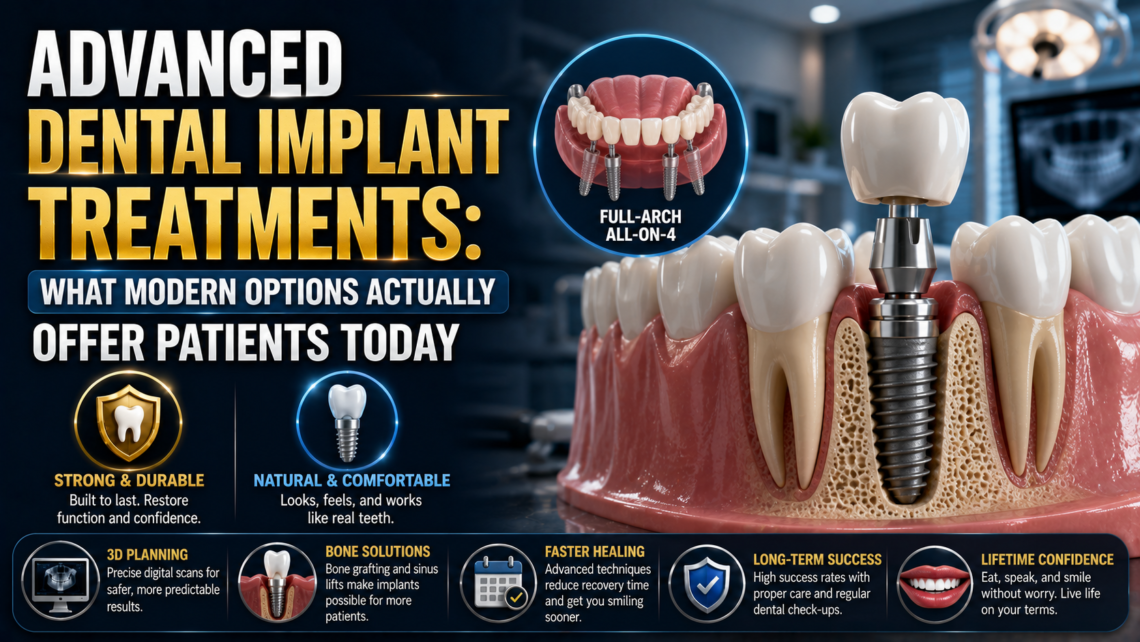
This is where implant dentistry has changed the most for patients dealing with extensive tooth loss or full dentures. Instead of placing an individual implant for every missing tooth, which can mean six or more implants per arch, the All-on-4 technique uses four strategically angled implants to support a full arch of replacement teeth. Two implants go in at the front of the jaw, and two are angled toward the back, positioned to take advantage of denser bone and avoid the sinus cavities or nerve pathways that often limit options in the back of the mouth.
Variations exist, including All-on-5 and All-on-6 for patients who need or want additional support, but the underlying logic is the same: fewer implants, strategically placed, supporting a full prosthetic arch. For patients who have struggled with loose or uncomfortable dentures for years, this is often the treatment that changes daily life the most, since it restores a level of chewing function and stability that a removable denture simply can’t match.
Zygomatic Implants
For patients who have lost significant bone in the upper jaw, often after years of denture wear or long-term tooth loss, standard implants may not have enough bone to anchor into. Zygomatic implants solve this by anchoring into the zygomatic bone, the cheekbone, which is denser and less prone to the bone loss that affects the jaw over time. This is a more complex surgical procedure and isn’t the first option a dentist reaches for, but it has become a genuine alternative to extensive bone grafting for patients who would otherwise face a much longer treatment timeline.
Bone Grafting and Sinus Lifts
Not every patient has enough bone volume to support an implant right away, particularly after a tooth has been missing for years, since the jawbone naturally resorbs once it’s no longer being stimulated by tooth roots. Bone grafting adds material, either from the patient’s own body, a donor source, or a synthetic substitute, to rebuild that volume before or during implant placement. In the upper back jaw, where the sinus cavity often sits close to the bone, a sinus lift procedure gently raises the sinus floor to create enough vertical space for an implant.
These procedures add time to the overall treatment, sometimes several months for the graft to fully integrate before implants can be placed, but they’re often the difference between a patient being a candidate for implants at all versus needing a removable alternative.
Digital Implant Planning and Guided Surgery
One of the more meaningful shifts in the last decade has been the move toward fully digital treatment planning. A cone beam CT scan combined with a digital impression of the mouth lets a dentist or oral surgeon plan the exact position, angle, and depth of each implant on a computer before surgery even begins. That plan can then be used to create a surgical guide, a custom device that fits over the teeth or gums and directs the drill to the exact planned position during the procedure.
The practical benefit here is real, not just marketing language. Guided surgery reduces the margin for error, often shortens surgical time, and in many cases allows for smaller incisions and faster recovery compared to freehand placement.
How Dentists Decide Which Treatment Fits
A good implant consultation isn’t really about which treatment sounds most impressive. It’s a structured evaluation of a few specific factors.
Bone volume and density determine whether a patient can move straight to implant placement or needs grafting first. This is assessed through imaging, not just a visual exam.
Number and location of missing teeth shapes whether single implants, a partial bridge supported by implants, or a full-arch solution makes more sense. Someone missing one molar has a very different treatment path than someone who has lost most of their upper teeth.
Overall health and healing capacity matters more than people expect. Conditions like uncontrolled diabetes, certain autoimmune disorders, and smoking all affect how well bone fuses to an implant, and a responsible dentist will address these factors before committing to a treatment plan.
Bite and jaw alignment influence how forces will be distributed across the implants once they’re in function, which affects long-term durability.
Patient goals and timeline are part of the equation too. Some patients prioritize the fastest possible path to a functional smile, others prioritize the most conservative approach even if it takes longer. Both are valid, and a good treatment plan accounts for which one matters more to the specific patient.
Common Mistakes and Misconceptions
Assuming implants are a same-day fix for everyone. Same-day loading is only appropriate for patients with strong primary stability. Marketing that promises this to every patient regardless of bone quality is oversimplifying a decision that should be based on imaging, not a sales pitch.
Underestimating the role of bone grafting. Some patients hear “you need a bone graft” and assume it means something has gone wrong or that they’re a difficult case. In reality, bone loss after missing teeth is extremely common, and grafting is a routine, well-established part of implant planning for a large share of patients.
Confusing All-on-4 with getting four separate crowns. All-on-4 refers to four implants supporting an entire arch of connected replacement teeth, not four individual tooth replacements. This confusion leads some patients to misjudge both the cost and the outcome they should expect.
Choosing a provider based on price alone. Implant dentistry has a wide price range, and the lowest quote isn’t automatically a bad choice, but it’s worth understanding what’s included. Some quotes cover only the implant fixture, with imaging, the abutment, and the final crown priced separately. A full picture of total cost matters more than the number on the first estimate.
Ignoring long-term maintenance. Implants don’t get cavities, but the gum and bone around them can still develop a condition called peri-implantitis if oral hygiene and regular checkups are neglected. Treating an implant as “permanent and maintenance-free” is a common and costly misconception.
A Practical Comparison of Major Treatment Options
| Treatment | Best suited for | Typical timeline | Relative complexity |
|---|---|---|---|
| Single-tooth implant | One missing tooth, adequate bone | 3 to 6 months | Lower |
| Same-day implant | Strong bone density, good candidate for immediate load | Days to weeks for temporary crown, months for final | Moderate |
| All-on-4 / full-arch | Extensive tooth loss or full dentures | Often 1 day for temporary teeth, months for final prosthesis | Higher |
| Zygomatic implants | Severe upper jaw bone loss | Longer surgical planning, similar loading options to All-on-4 | High |
| Bone graft plus implant | Insufficient bone volume | Several months of graft healing before implant placement | Moderate to high |
Actionable Steps Before Choosing a Treatment
- Get a full imaging workup before agreeing to any treatment plan. A 3D scan tells your dentist far more than a visual exam or a flat X-ray, and it should inform every recommendation that follows.
- Ask specifically what’s included in a quoted price. Implant fixture, abutment, crown, imaging, and any grafting should each be itemized, not bundled vaguely.
- Ask about the specific implant brand and material being used. Reputable systems have long clinical track records; this is a fair and reasonable question to ask any provider.
- Get a second opinion for full-arch or zygomatic cases. These are higher-complexity procedures where treatment philosophy can vary meaningfully between practices.
- Address health factors like smoking or uncontrolled blood sugar before surgery if possible. These directly affect healing success rates and are worth discussing honestly with your dentist.
- Plan for the maintenance phase, not just the surgery. Ask what your follow-up schedule and home care routine should look like once the implant is placed.
Where the Field Is Heading
Digital planning and guided surgery are becoming standard rather than premium add-ons in many practices, which is gradually narrowing the gap between a routine implant case and a complex one in terms of predictability. Material science continues to improve as well, with zirconia implants gaining traction as a metal-free alternative for patients who prefer it, though titanium remains the most extensively studied and widely used option. The overall direction is fairly clear: fewer surgical visits, more precise planning, and treatment paths that adapt to a wider range of bone and health conditions than were treatable a decade ago.
Final Thoughts
The right implant treatment isn’t the newest one or the most heavily marketed one. It’s the one that matches your bone structure, your health profile, and what you actually need to eat, speak, and smile comfortably again. Advanced techniques like guided surgery, All-on-4, and zygomatic implants have genuinely expanded who qualifies for a fixed, permanent solution instead of a removable one, but none of them replace a careful, imaging-based evaluation from a qualified dentist or oral surgeon.
If you’re considering implants, walk into that first consultation with real questions: what does the imaging show, what’s actually included in the cost, and what does your specific case require rather than what sounds most impressive on a clinic’s website.
Frequently Asked Questions
How long do dental implants typically last? With good oral hygiene and regular dental checkups, implant fixtures often last well over a decade, and many last a lifetime. The crown attached to the implant may need replacement after 10 to 15 years due to normal wear.
Are dental implants painful? Most patients report the procedure itself is done under local anesthesia with manageable discomfort afterward, often compared to the recovery from a tooth extraction. Pain typically peaks in the first few days and improves quickly with standard aftercare.
Can I get implants if I’ve lost bone in my jaw? Yes, in most cases. Bone grafting, sinus lifts, or alternative approaches like zygomatic implants are specifically designed for patients who don’t have enough natural bone volume for a standard implant.
What’s the difference between All-on-4 and traditional dentures? All-on-4 implants are fixed to the jawbone and don’t require adhesives or removal, offering significantly more chewing stability than a removable denture, which rests on the gums and can shift or loosen over time.
How much do dental implants typically cost? Cost varies widely based on the number of implants, whether grafting is needed, and the type of restoration. Single-tooth implants and full-arch procedures like All-on-4 sit at very different price points, so a detailed, itemized quote from your provider is the most reliable way to understand your specific cost.
Is same-day implant treatment right for everyone? No. It depends on bone density and implant stability immediately after placement. A dentist determines candidacy through imaging and clinical assessment, not simply patient preference.
Do dental implants require special maintenance? Yes. While implants don’t decay like natural teeth, the surrounding gum and bone need regular brushing, flossing, and professional checkups to prevent peri-implantitis, a gum condition that can affect implant stability if left untreated.
Am I too old to get dental implants? Age alone rarely disqualifies someone from implants. Candidacy is based more on bone health, overall medical condition, and healing capacity than on age itself, and many patients in their 70s and 80s are successful implant candidates.
Read More: Provascin Guide: Benefits, Ingredients & Heart Health