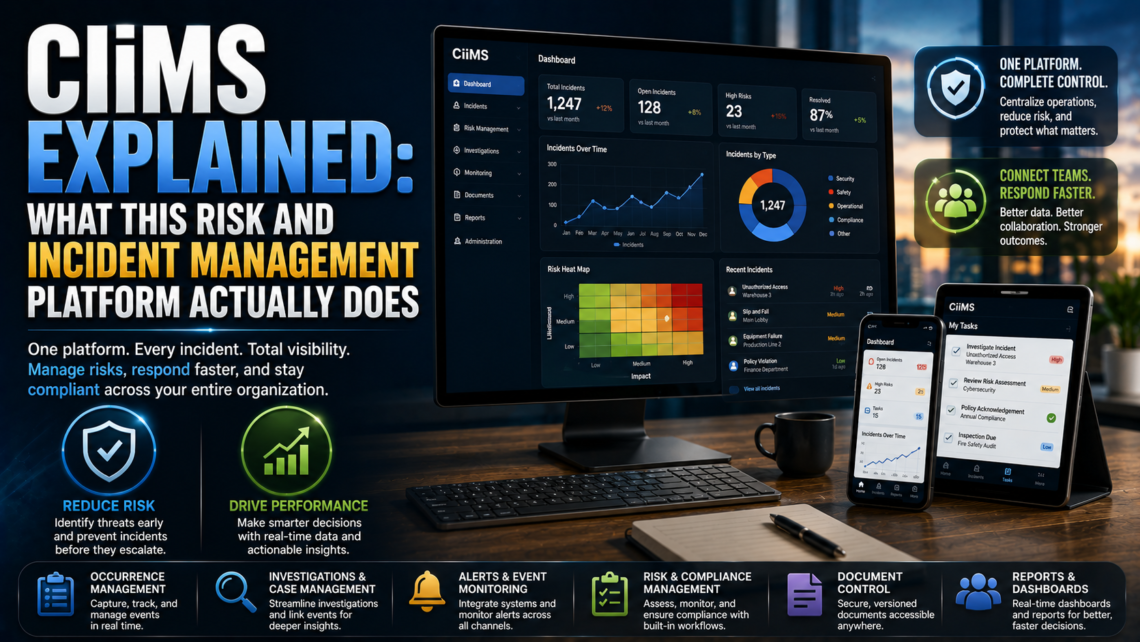
CiiMS Explained: What This Risk and Incident Management Platform Actually Does
If you searched for “ciims,” there is a good chance you came across it while researching software for security, risk, or incident management, or perhaps you saw the name attached to a hospital or a medical records system and were not sure which one applied to you. The term shows up in more than one context, so this guide focuses on the meaning most people are actually looking for: CiiMS as an enterprise risk and operations management platform, while also briefly clearing up the other uses of the name so you land on the right information.
A Quick Note on the Different Meanings of CiiMS
Before going further, it helps to separate the main uses of this name, since confusing them can waste your time.
The most common meaning, and the focus of this article, is CiiMS as a software platform built for enterprise risk management, incident recording, and operational monitoring. It is used by organizations that need to track occurrences, manage investigations, and oversee security or compliance activity across large or distributed teams.
Separately, the same short name is also used by a hospital and medical institute in India and by certain cardiac imaging and information systems in healthcare technology discussions. If you were searching for a hospital, appointment booking, or a medical imaging system, this article will not be the right resource, since it focuses entirely on the software platform used for risk and incident management.
With that distinction out of the way, here is what the platform version of CiiMS actually involves.
What Is CiiMS
CiiMS is a centralized software platform designed to help organizations manage operational activity, security incidents, risk, and compliance from a single system. Rather than relying on separate spreadsheets, paper occurrence books, or disconnected tools for different departments, CiiMS brings these functions into one place so that information flows consistently across a business.
At its core, the platform is built around recording occurrences and events as they happen, then routing that information through structured workflows so the right people can review, escalate, or act on it. This applies to a wide range of situations, from a security guard logging a routine patrol note to a formal investigation into a serious incident.
The platform has been developed and refined over more than two decades, which shows in how thoroughly it covers different operational needs rather than treating incident logging as an afterthought bolted onto other software.
Why Organizations Use a System Like This
Understanding the reasoning behind adopting a platform like CiiMS makes the rest of this article easier to follow.
Fragmented record-keeping creates real risk. When incidents are logged in different formats across different departments, patterns become hard to spot. A minor issue in one location might be part of a larger trend that nobody notices because the data lives in ten different spreadsheets instead of one system.
Manual occurrence books slow everything down. Physical logbooks and manual paperwork are still common in security and operations, but they are slow to search, easy to lose, and difficult to analyze. Digitizing this process turns scattered notes into structured, searchable records.
Compliance and audits demand consistency. Regulated industries need clear documentation of incidents, inspections, and responses. A centralized system makes it far easier to produce accurate records when auditors or regulators come asking.
Multi-site and multi-country operations need a shared language. Large organizations often operate across regions with different teams, terminology, and even languages. A platform built with multilingual support allows the head office and local teams to work from the same underlying system without losing local context.
Risk forecasting depends on data you can actually analyze. Spotting a risk before it becomes a crisis requires enough historical data, recorded consistently, to identify patterns. That is difficult to do with inconsistent paper trails but far more realistic with structured digital records.
Core Modules and Capabilities
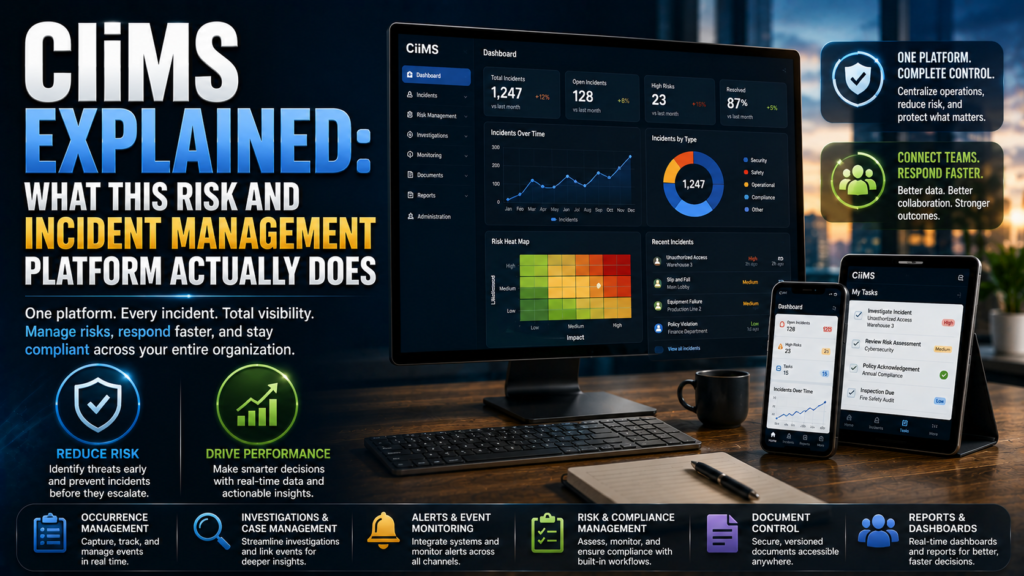
CiiMS is not a single tool but a suite of connected modules, each addressing a different part of operational and risk management. Knowing what each part does helps you understand where it might fit into your own organization.
Occurrence and operations management covers the day-to-day recording of events, incidents, and activities. This includes standard operating procedures, checklists, inspections, and job cards, giving frontline teams a structured way to log what happens during daily operations.
Risk management and forecasting focus on identifying, assessing, and monitoring threats before they escalate. This module is built around the idea that early warning signs, if captured and analyzed properly, can help an organization respond before a small problem becomes a major one.
Document management handles version-controlled policies, procedures, and other official documents. Instead of emailing outdated files back and forth, teams can access a single, current version organized by department or theme.
Investigative case management supports more serious situations that require formal investigation, such as fraud, misconduct, or security breaches. This includes tools for profiling, linking related pieces of information, and analyzing data across a case.
Alarm and event monitoring deals with high-volume alerts coming from third-party systems such as access control, video surveillance, telematics, or other connected technologies. Rather than staff manually watching dozens of separate dashboards, this module consolidates alerts into one monitoring environment.
Public and employee reporting tools give a simple, secure way for people outside the core operations team, such as employees or the public, to report incidents, concerns, or complaints directly into the system, complete with supporting documents or attachments.
Mobile access extends the platform to phones and tablets, so field staff can log occurrences, respond to tasks, and access information without needing to be at a desk or near a physical logbook.
How CiiMS Compares to Traditional Manual Systems
| Aspect | Manual or Paper-Based System | CiiMS Platform |
|---|---|---|
| Record consistency | Varies by person and location | Standardized fields and workflows |
| Searchability | Slow, often requires manual review | Instant search across records |
| Multi-site visibility | Limited, requires manual compilation | Centralized dashboards across sites |
| Risk pattern detection | Difficult with scattered data | Supported through structured historical data |
| Language and regional use | Often locked to one language or format | Multi-language support built in |
| Mobile field reporting | Rare or informal | Native mobile app for field access |
| Audit readiness | Time-consuming to compile | Records already structured for reporting |
This comparison is not meant to suggest manual systems are without value in every context. Small operations with very limited incident volume may not need this level of structure. The advantage of a platform like CiiMS becomes clearer as the number of sites, staff, and incident types grows.
Common Misconceptions
A few misunderstandings come up often when people first look into a system like this.
Misconception one: it is only for security teams. While CiiMS has strong roots in security and incident monitoring, the platform also covers operations, compliance, document control, and investigations, making it relevant to risk, legal, and operations departments as well.
Misconception two: adopting it means replacing every existing tool overnight. Most organizations phase in a platform like this gradually, often starting with occurrence logging before expanding into risk forecasting, document management, or investigative case handling.
Misconception three: more automation means less human judgment. The forecasting and monitoring tools are designed to support decision-making, not replace it. Analysts and managers still interpret the data and decide how to respond; the system simply gives them better information to work with.
Misconception four: multi-language support means separate systems for each region. In a properly configured setup, different regional teams can work in their own language within the same underlying platform, rather than each region running an entirely separate, disconnected system.
Practical Steps for Evaluating or Implementing a System Like This
If your organization is considering a platform in this category, a structured approach tends to work better than trying to roll everything out at once.
Start by mapping your current incident and risk workflow. Identify where occurrences are currently logged, who reviews them, and where information tends to get lost or delayed between steps.
Identify your highest-risk gaps first. Rather than implementing every module simultaneously, prioritize the areas causing the most operational pain, whether that is inconsistent incident logging, slow investigations, or difficulty producing audit documentation.
Involve frontline staff early. The people filling out occurrence reports daily will notice usability problems long before management does. Their feedback during setup can prevent a system that looks good on paper but gets ignored in practice.
Plan for integration with existing tools. If your organization already uses access control, video surveillance, or other monitoring technology, check how a new platform connects with those systems rather than requiring a complete technology overhaul.
Set clear escalation rules from the start. A system is only as useful as the workflows behind it. Decide early who gets notified for different incident types and severity levels, so the platform reflects real accountability rather than just digital paperwork.
Test reporting and audit output before going live. Since compliance and audit readiness is often a core reason for adopting this kind of system, confirm early that the reports it generates actually match what your auditors or regulators expect to see.
Train for adoption, not just software use. Staff need to understand why consistent, timely logging matters, not just which buttons to click. Systems fail more often from poor adoption than from poor technology.
A Simple Example
Consider a company operating several warehouses across different regions. Before adopting a centralized system, each site manager tracked incidents in their own spreadsheet, using different categories and levels of detail. When head office needed a regional risk summary, someone had to manually compile and reconcile data from a dozen inconsistent files, often taking days and still missing some records.
After moving to a centralized platform, each site logs occurrences using the same structured fields. A minor safety incident at one warehouse and a similar incident at another site are now recorded in a comparable way, making it possible to notice a pattern across locations rather than treating each event as an isolated case. When an audit is required, the reporting is already structured and ready, cutting preparation time significantly compared to the old manual process.
Checklist for Choosing an Incident and Risk Management Platform
- The system supports structured, searchable occurrence logging across all sites
- Risk and incident data can be analyzed for patterns over time
- Document management includes version control for policies and procedures
- The platform supports the languages and regions your organization operates in
- Mobile access is available for field staff and frontline teams
- Integration with existing security and monitoring technology is possible
- Reporting output matches what your compliance or audit requirements demand
- Escalation workflows reflect your actual organizational structure and accountability
Conclusion
CiiMS, in its most widely searched meaning, refers to a centralized platform built to bring structure to incident recording, risk management, operations, and compliance across an organization. Its value becomes clearest in environments where information used to be scattered across paper logs, spreadsheets, and disconnected tools, since bringing that information into one consistent system makes patterns visible, audits faster, and response times shorter. Whether a platform like this makes sense for your organization depends on the scale of your operations and how costly your current gaps in visibility and consistency already are. For smaller, simpler operations, a lighter approach may be enough. For larger, multi-site, or highly regulated organizations, the shift from scattered manual records to a structured system tends to pay for itself through faster audits, clearer risk visibility, and fewer missed patterns.
Frequently Asked Questions
What does CiiMS actually stand for? In its main software context, CiiMS refers to an integrated platform for incident, information, and risk management, though the exact expansion of the name can vary depending on the provider using it.
Is CiiMS the same as the hospital in India with a similar name? No. The hospital and medical institute using a similar short name are completely separate entities from the risk and incident management software platform described in this article.
What industries typically use a platform like CiiMS? Security, retail, logistics, manufacturing, and other multi-site or highly regulated industries commonly use platforms in this category, since they benefit most from centralized incident tracking and risk forecasting.
Does CiiMS replace physical security staff or monitoring teams? No. It is designed to support human decision-making by organizing and analyzing incident data, not to replace the people who respond to and investigate incidents.
Can a platform like this work across multiple countries and languages? Yes. Multi-language support is a core feature of enterprise-level systems in this category, allowing regional teams to work in their own language while feeding into a single centralized system.
Is mobile access available for field staff? Yes. A companion mobile app is typically available so frontline staff can log occurrences and access information without being tied to a desk.
How long does it take to implement a system like this? Implementation timelines vary widely depending on organization size and how many modules are being rolled out at once. Many organizations start with core occurrence logging before expanding into risk forecasting, document management, or investigative case handling.
Is this type of platform only useful for large enterprises? Larger, multi-site, or highly regulated organizations tend to see the clearest benefit, though mid-sized organizations with compliance requirements or multiple locations can also find value in centralized incident and risk tracking.
Read More: Pxless Explained: Why Designers Are Moving Away From Pixels